Hiding vegetables in children’s food is one of the oldest tricks in the parenting book — and for good reason. On a busy weeknight, blending a few vegetables into a meal your child already loves can mean the difference between a battle and an empty bowl. Here’s how to hide vegetables well, and why you shouldn’t only hide them.
But hiding vegetables works best when you know which ones disappear without a trace, which dishes hide them best, and when it’s time to let your child in on the secret. This guide covers all three.
Key takeaways
- Choose mild vegetables that match the colour of the dish: squash and carrot in orange sauces, cauliflower in white ones, spinach in green.
- Blend until completely smooth — texture gives the game away faster than taste.
- Hide and show: serve the same vegetable in its real form on the side, with no pressure.
The best vegetables to hide
Not every vegetable is a good undercover agent. The best ones have a mild flavour, cook down soft, and blend smoothly.
| Vegetable | Why it works | Hide it in |
|---|---|---|
| Butternut squash | Sweet, bright orange, silky when blended | Mac and cheese, pasta sauce, soups |
| Cauliflower | Neutral taste, creamy texture | White sauces, mash, cheese sauce |
| Carrot | Naturally sweet, disappears when grated | Tomato sauce, bolognese, muffins |
| Spinach | Almost tasteless when blended with fruit | Smoothies, pancakes, pesto |
| Courgette (zucchini) | Mild and watery, melts into bakes | Muffins, meatballs, pasta sauce |
| Beetroot | Sweet and earthy, gives a fun pink colour | Muffins, brownies, pink pancakes |
| Sweet potato | Sweet, smooth, orange | Mac and cheese, pancakes, nuggets |
Five dishes that hide vegetables brilliantly
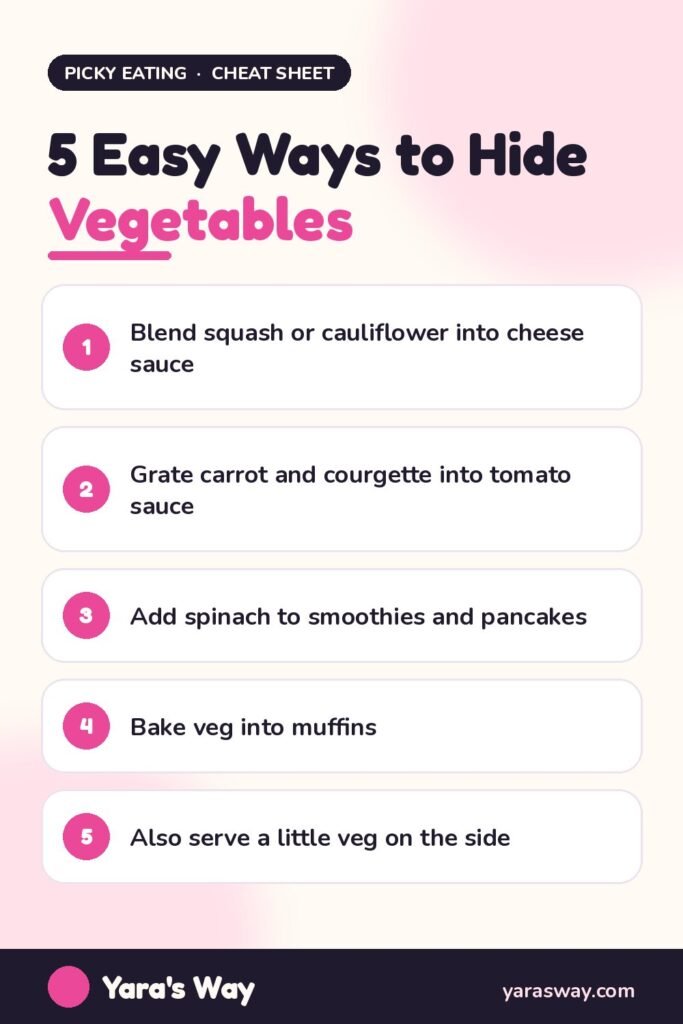
1. Cheese sauces
A blend of butternut squash and cauliflower makes a cheese sauce that looks and tastes like the classic, with a full serving of vegetables inside. It’s the idea behind our Hidden-Veggie Monster Mac & Cheese.
2. Tomato sauces
Red sauces can hide almost anything orange or red: grated carrot, red pepper, squash or even a few lentils. Simmer and blend for pizza and pasta. Our mini veggie pizzas use a grated-carrot sauce.

3. Smoothies
Baby spinach is the gateway vegetable for smoothies. Blend it with milk first, then add sweet fruit like banana and mango. Try our Green Monster Smoothie.
4. Pancakes and muffins
Grated or puréed vegetables keep bakes moist. Spinach turns pancakes a fun green, and beetroot makes muffins pink — see our Spinach Monster Pancakes and Beetroot Pink Muffins.
5. Meatballs, burgers and nuggets
Finely grated courgette, carrot or mushroom mixed into minced meat or chicken adds moisture and goodness without changing the flavour much.
Our top tips to hide vegetables successfully
- Match the colour. Orange vegetables in orange sauces, white in white. A sauce that suddenly changes colour will be noticed.
- Blend it smooth. Children are very sensitive to texture. A blender gives much better results than a masher.
- Cook vegetables until very soft before blending, so there are no grainy bits.
- Start small. Begin with a little and increase the amount over a few weeks as your child gets used to the taste.
- Keep the presentation familiar. Serve it in the usual bowl, with the usual spoon.
Why it’s not enough to hide vegetables
Hidden vegetables add nutrition, but they don’t teach children to like vegetables. If broccoli only ever appears blended into sauce, your child never gets the chance to become familiar with what broccoli looks, smells and tastes like on its own.
Children learn to accept foods through repeated, positive exposure. That’s why we recommend combining hiding with showing.
The “hide and show” approach
- Hide: add blended vegetables to meals your child already enjoys, so everyday food carries more nutrition.
- Show: at the same meal, put a small amount of the same vegetable on the plate in its real form — a few roasted squash cubes, a cauliflower floret — with absolutely no pressure to eat it.
- Tell: once a recipe is a firm favourite, let your child in on the secret. Many children are delighted to discover they’ve been eating vegetables all along, and are more curious to try them in other forms.
This way your child gets the nutrition now, and builds the familiarity that leads to happily eating vegetables later.
Is it dishonest to hide vegetables?
Some parents worry that hiding vegetables is a kind of trick that could damage trust. We think of it more like seasoning — you don’t announce every ingredient in a meal. The key is not to lie if your child asks directly. If they ask “Is there something green in this?”, it’s fine to say “Yes! It’s spinach — that’s what makes it so bright.” Honesty plus a delicious meal is a powerful combination.
A simple week to hide vegetables
- Monday: Squash and cauliflower mac and cheese, with a few roasted squash cubes on the side.
- Tuesday: Spinach pancakes for breakfast; carrot sticks at lunch.
- Wednesday: Pasta with a grated-carrot tomato sauce.
- Thursday: Green smoothie after school.
- Friday: Build-your-own pizzas with veg toppings to choose from.
Small, steady additions like these add up to many more vegetables over a week — without a single argument at the table.
When to hide vegetables, and when to show them
It makes sense to hide vegetables when your child is going through a very fussy phase, when they’re unwell and eating little, or simply on busy nights when you want a guaranteed nutritious meal. It’s also a gentle way to hide vegetables while you work on other strategies, like the division of responsibility.
But if you only hide vegetables, children never get the chance to learn to like them. That’s why we always show some too: a few peas on the side, a carrot stick with dinner, a colourful salad on the table. Over time, try to hide vegetables a little less and show them a little more. For ideas, read our guides to vegetables for kids and trying new foods. Learning how to hide vegetables is a useful skill; learning when to stop hiding them is just as important.
Frequently asked questions
Do hidden vegetables still count towards my child’s five a day?
Yes. A portion of vegetables blended into a sauce or baked into muffins still provides fibre, vitamins and minerals. A small child’s portion is roughly what fits in the palm of their hand, so a sauce packed with carrot, squash and pepper can contribute a good amount.
Will my child notice if I hide vegetables?
Sometimes! Start with mild, sweet vegetables such as carrot, butternut squash and cauliflower, blend them very smoothly and begin with a small amount. Increase it gradually as your family gets used to the taste.
Are frozen vegetables okay to use?
Absolutely. Frozen vegetables are picked and frozen quickly, they are just as nutritious as fresh and they are ideal for sauces and smoothies. Keeping a bag of frozen spinach, peas and mixed vegetables in the freezer makes hiding them easy on busy nights.
The bottom line
Hiding vegetables is a useful tool for busy parents, especially during fussy phases. Use it alongside, not instead of, serving vegetables your child can see, touch and taste. Over time, the hidden portions keep nutrition steady while the visible ones build familiarity, and that combination is what turns vegetable-avoiders into vegetable-eaters.
Sources and further reading