Food chaining is a gentle way to help a picky eater try new foods by starting with something they already love. Instead of jumping from chicken nuggets straight to grilled salmon, you build a “chain” of small, safe steps where each new food is only a little different from the last.
It was developed by feeding specialists for children with very limited diets, but the basic idea works brilliantly for everyday fussy eaters too. Here’s how food chaining works, five simple steps to try at home, and some real example chains you can borrow.
Key takeaways
- Food chaining links a food your child accepts to new foods with similar taste, texture or look.
- Each step changes only one thing, so the new food never feels like a big leap.
- Progress is slow and that’s fine: many children need several tastes before accepting a food.
- If your child eats fewer than about 20 foods or is losing weight, speak to your GP.
What is food chaining?
Children who are wary of new food usually rely on a short list of “safe” foods. These tend to be predictable: the same colour, the same crunch, the same brand every time. Food chaining uses that predictability rather than fighting it.
You start with a safe food and look at what your child likes about it. Is it the crunch? The mild taste? The fact that it’s beige? Then you choose a new food that shares most of those features and changes just one thing. Once that link is accepted, you move one more small step along the chain.
Because each change is tiny, the new food feels familiar. Over weeks and months, those small steps can carry a child surprisingly far from where they started.
Why food chaining works
Many children are naturally cautious about new food, especially between the ages of two and five. Seeing, smelling and tasting a food again and again helps it feel safe. The NHS notes that children may need to try a new food many times before they accept it.
Food chaining makes those repeated tastes easier, because each new food is close to something your child already trusts. It also takes the pressure off mealtimes: you’re not asking for broccoli, just a slightly different cracker.

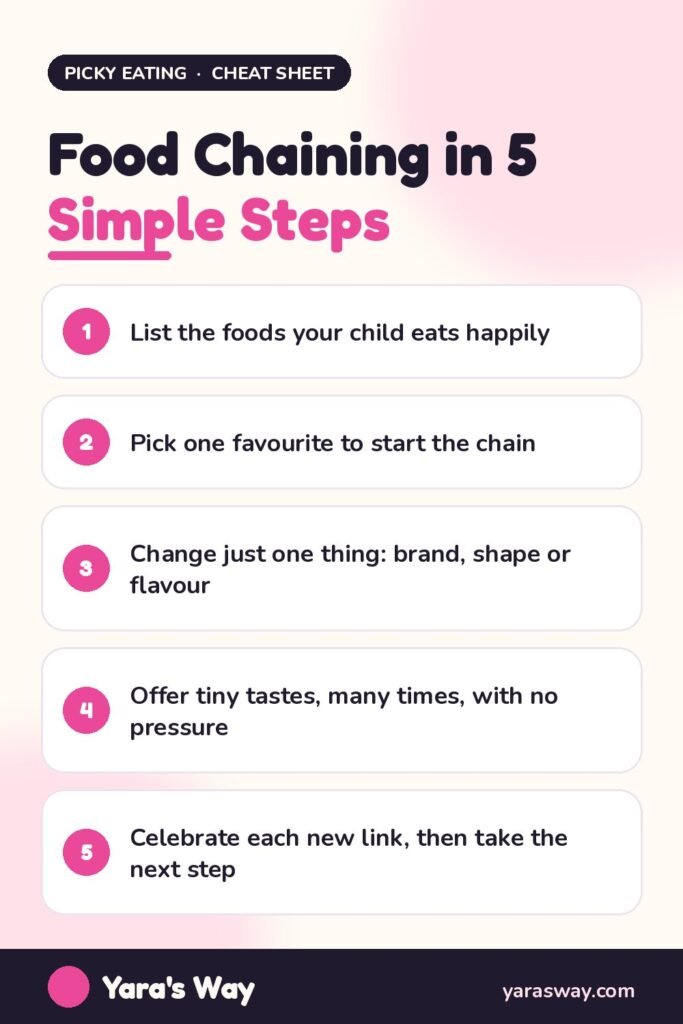
Food chaining in 5 simple steps
Step 1: Make a list of safe foods
For one week, write down everything your child eats without a fuss, including brands and how it’s served. This is your starting point. You’ll probably notice patterns: lots of crunchy foods, perhaps, or nothing with sauce.
Step 2: Choose a starting food
Pick one well-loved food that your child eats almost every day. It’s easier to build a food chaining sequence from a strong favourite than from something they only tolerate.
Step 3: Change just one thing
Choose a next step that differs in only one way. You might change the brand, the shape, the flavour, the colour or the temperature, but not several at once. Plain crackers might become crackers of a different brand, then a slightly different shape, then a cracker with a mild cheese flavour.
Step 4: Offer tiny tastes without pressure
Serve the new food alongside the safe food, in a very small amount. Let your child look, touch, lick or take a crumb-sized bite. Praise curiosity, not eating. If they push it away, that’s okay; try again another day.
Step 5: Lock it in, then take the next step
Once the new food is accepted a few times, keep it in the rotation so it stays familiar. Then choose the next link. Some families move on every week; others take a month. Let your child set the pace.
Example food chaining sequences
These are examples to inspire you. Your own chain should follow what your child likes.
| Start with | Small steps | Goal food |
|---|---|---|
| Chicken nuggets | Homemade breaded chicken strips → breaded fish fingers → homemade fishcakes | Baked salmon |
| Plain pasta | Pasta with butter → pasta with a little cheese → hidden-veggie mac and cheese | Pasta with tomato sauce |
| Crisps | Baked crisps → vegetable crisps → oven-baked potato wedges | Roasted carrot sticks |
| Plain toast | Toast with butter → toast with cream cheese → mini pitta pizza | Mini veggie pizzas |
| Strawberry yoghurt | Strawberry yoghurt with mashed strawberry → plain yoghurt with strawberry → strawberry banana smoothie | Fresh strawberries |
Tips for successful food chaining
- Keep safe foods available. Food chaining adds foods; it never takes favourites away.
- Use “food play”. Washing, stirring and arranging foods builds familiarity without any pressure to eat.
- Involve your child. Let them choose between two possible next steps at the shop.
- Be consistent. Offer the new link several times a week, not once and then forget it.
- Celebrate small wins. Licking a new food is progress. So is letting it sit on the plate.
Food chaining works well alongside other gentle strategies. Our guide to trying new foods has ideas for making tastes fun, and the division of responsibility helps keep mealtimes calm while you work through each chain.

Common food chaining mistakes
- Changing too much at once. If the new food is rejected, go back a step and make a smaller change.
- Hiding the change. Food chaining is honest. Tell your child it’s a slightly different version; surprises can break trust.
- Rushing. A chain that takes three months is still a success.
- Using pressure or rewards. Bribes and “one more bite” rules often make children more anxious about food.
When to get extra help
Most picky eating is a normal phase. But talk to your GP or health visitor if your child eats a very small number of foods (often fewer than about 20), gags or vomits with new textures, is losing weight or not growing as expected, or if mealtimes are causing real distress. They may refer you to a dietitian or a feeding therapist, who can design a food chaining plan with you.
For more everyday ideas, read our picky eater survival guide and our tips on ending mealtime battles.
Frequently asked questions
How long does food chaining take?
It varies. Some children accept a new link in a few days; others need several weeks. Food chaining is a long-term approach, so measure progress over months rather than meals.
Can I use food chaining with a toddler?
Yes. Toddlers often respond well because the steps are small and playful. Keep portions tiny and let them explore food with their hands.
Is food chaining the same as hiding vegetables?
No. Hiding vegetables adds nutrition without your child knowing. Food chaining helps your child knowingly accept new foods. The two can work together; see our guide to hiding vegetables in kids’ food.
The bottom line
Food chaining turns a frightening leap into a series of tiny, manageable steps. Start with a food your child loves, change one thing at a time, and keep the mood relaxed. With patience, a short list of safe foods can slowly grow into a varied, healthy diet.
Sources and further reading