Fat has had a bad reputation for years, but healthy fats for kids are an essential part of a balanced diet. Children need fat for energy, for absorbing vitamins A, D, E and K, and for the development of their brains and eyes. In fact, young children need proportionally more fat than adults.
The key is choosing the right kinds. This guide explains why healthy fats for kids matter, the 10 best food sources, how dairy advice changes with age, and how much oily fish children should eat.
Key takeaways
- Children need fat for energy, growth and absorbing certain vitamins.
- Healthy fats for kids include oily fish, avocado, olive and rapeseed oil, nut and seed butters and eggs.
- Full-fat dairy is recommended up to age two; low-fat options can be introduced gradually after that.
- Limit foods high in saturated fat, like pastries, biscuits, cakes and processed meats.
Why children need fat
Fat is a concentrated source of energy, which matters for small children with small tummies and big growth needs. Fat also carries the fat-soluble vitamins A, D, E and K, so without enough fat the body can’t absorb them properly. Some fats, especially the omega-3 fats found in oily fish, are important for the development of the brain and eyes.
That’s why low-fat diets aren’t suitable for young children. Instead, the goal is to offer mostly healthy fats for kids and keep less healthy fats to occasional treats.
Types of fat explained
- Unsaturated fats (the healthier type) are found in oily fish, avocado, nuts, seeds and vegetable oils like olive and rapeseed oil.
- Omega-3 fats are a type of unsaturated fat, found mainly in oily fish such as salmon, sardines and mackerel.
- Saturated fats are found in butter, cheese, fatty meat, cakes, biscuits and pastries. Children can have some, but too much isn’t good for long-term heart health.
- Trans fats are found in some processed foods and are best avoided.

10 of the best healthy fats for kids
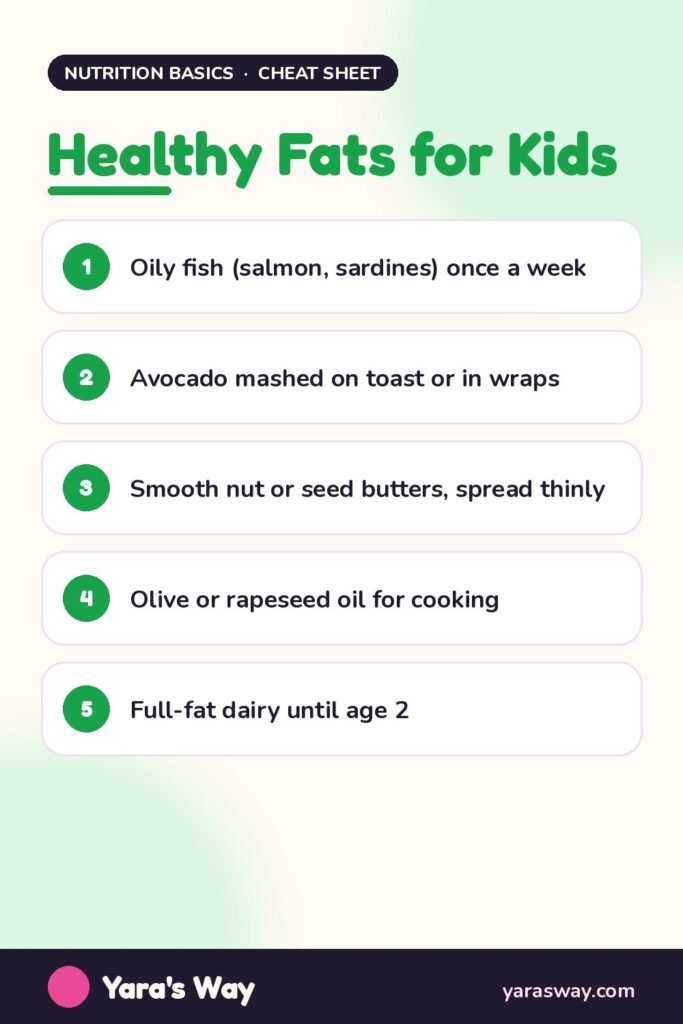
- Salmon: in fishcakes, pasta or baked with vegetables.
- Sardines and mackerel: mashed on toast for older children.
- Avocado: mashed on toast, in wraps or blended into smoothies.
- Olive oil: for roasting vegetables and making dressings.
- Rapeseed oil: great for everyday cooking and baking.
- Smooth nut butters: spread thinly on toast or apple slices. Never give whole nuts to children under five because of the choking risk.
- Ground seeds: chia, flax or pumpkin seeds stirred into porridge or yoghurt.
- Eggs: a family favourite that also provides protein.
- Full-fat yoghurt and cheese: especially for under-twos.
- Hummus: made with olive oil and tahini (check school allergy policies).
Full-fat or low-fat dairy?
The NHS gives clear guidance that changes with age:
| Age | Dairy advice |
|---|---|
| Under 1 | Breast milk or first infant formula as the main drink |
| 1 to 2 years | Whole or semi-skimmed milk as a main drink; full-fat cheese, yoghurt and fromage frais |
| From 2 years | Lower-fat dairy can be introduced gradually, if your child is a good eater and growing well |
| Under 5 years | Skimmed and 1% milk aren’t suitable as a main drink (they can be used in cooking) |
How much oily fish should children eat?
Oily fish is one of the best healthy fats for kids because it’s rich in omega-3. The NHS recommends giving children at least one portion of oily fish a week. Because oily fish can contain low levels of pollutants, boys should have no more than four portions a week and girls no more than two. The NHS is clear that the health benefits outweigh the risks, so there’s no need to avoid oily fish.
Children shouldn’t eat shark, swordfish or marlin, which can contain high levels of mercury.
Easy ways to add healthy fats for kids
- Swap butter for olive or rapeseed oil when roasting vegetables.
- Add mashed avocado to sandwiches instead of mayonnaise.
- Make salmon fishcakes or a fish pie once a week.
- Stir ground seeds into porridge, like the toppings in our healthy breakfast ideas.
- Offer apple slices with a thin layer of smooth nut butter, like our Crunchy Apple Nachos.
- Blend avocado into a Green Monster Smoothie for creaminess.
Fats to limit
Saturated and processed fats are fine occasionally, but they shouldn’t make up a large part of a child’s diet. Keep pastries, cakes, biscuits, crisps, fried takeaway food and processed meats like sausages and bacon as occasional foods. Many of these are also high in salt and sugar; see our guide to reducing sugar for kids.
Healthy fats for kids who don’t eat fish
If your child doesn’t eat fish, include plant sources of omega-3 such as ground flaxseed, chia seeds, walnuts (ground, for under-fives) and rapeseed oil. The body converts these less efficiently than the omega-3 in fish, so if your child is vegetarian or vegan, it’s worth discussing omega-3 with your GP or a dietitian. Our guide to protein for kids has more plant-based ideas, and our iron for kids guide covers another nutrient to watch.
A week of healthy fats for kids
Adding healthy fats for kids doesn’t mean changing every meal. A few simple swaps across the week make a real difference:
- Monday: avocado toast for breakfast.
- Tuesday: vegetables roasted in rapeseed oil.
- Wednesday: salmon fishcakes with peas.
- Thursday: ground seeds stirred into porridge.
- Friday: apple slices with smooth nut butter after school.
Over a week, these swaps add omega-3, vitamin E and unsaturated fats, while naturally pushing out some of the processed snacks. That’s the easiest way to make healthy fats for kids part of everyday family food.
Frequently asked questions
Is butter bad for kids?
No, butter is fine in small amounts. For everyday cooking, vegetable oils like olive and rapeseed oil are healthier choices.
Can toddlers have avocado?
Yes. Ripe, mashed avocado is a great first food and one of the best healthy fats for kids of all ages.
Should I give my child fish oil supplements?
Most children don’t need them if they eat oily fish regularly. Ask your GP or pharmacist before giving any supplement.
The bottom line
Healthy fats for kids fuel growth, support developing brains and help the body use important vitamins. Offer oily fish weekly, cook with olive or rapeseed oil, enjoy avocado, eggs and nut butters, follow the age-based dairy advice and keep processed fats as occasional treats.
Sources and further reading